Everything You Need To Know About Trauma and PTSD
You know something happened to you. What you can't figure out is why other people walked away from the same kind of event and you're still here, months or years later, carrying it in your body.
The memory still has a hold on you. It shows up at the worst times, uninvited. Your sleep is off, your nerves are frayed, and some days you quietly wonder if you're losing it while everyone around you seems fine.
You're not losing it. What you're describing is the lasting impact of trauma and PTSD, and there are real, well-understood reasons it works this way.
This guide breaks down what you actually need to know: what trauma is, how PTSD symptoms show up in the mind and body, what's happening in your brain after a traumatic event, and the treatment options that help people heal.
Knowing how post-traumatic stress disorder works won't undo what happened to you. But it's the first step toward loosening its grip.
What Is Trauma?
Trauma does not refer to the traumatic event itself; it is the resulting psychological impact of that event. This impact must be negative and enduring for the person to be considered traumatized.
Trauma can be thought of as an emotional injury.
Many events that can be traumatic to a person. Usually, a traumatic event makes the person fear for their life in some way, but this is not a requirement.
For example, childhood emotional neglect does not necessarily make the child feel like they are going to die, but it denies them enough emotionally responsive parenting that it can cause sometimes long-lasting trauma.
There are multiple categories of trauma, some of them overlapping: acute, chronic, complex, developmental, vicarious, racialized, historical, and intergenerational.
What Are “Big T” and Little T” Traumas?
Trauma can also be divided into “big T” traumas and “little t” traumas. “Big T” traumas refer to obvious, overwhelming, extremely stressful events where the affected person feared for their life or bodily integrity. Surviving a devastating tornado would fall into this category. “Little t” traumas are seen as having less impact that can nevertheless be long-lasting, like casual school bullying.
Any kind of assault, such as rape or a mugging; a serious accident, like a car crash or a near-drowning; hate crimes; natural disasters, domestic violence, severe illness or injury, the death of a loved one, divorce, and witnessing a death or violence are all common causes of trauma.
Trauma can also be caused by childhood abuse and neglect, whether it’s physical, sexual, or emotional.
Less obvious events, like infidelity, can be traumatic, too.

What Are the Symptoms of PTSD?
PTSD or posttraumatic stress disorder is a serious psychological condition that can result from experiencing a traumatic event. Not everyone who experiences trauma will develop PTSD, but up to 5.6% of people will. PTSD causes devastating symptoms that can really decrease the quality of life. Women are twice as likely to get PTSD as men, and PTSD is more common in Black, Latino, and Native American persons as well as those who identify as LGBTQIA+.
Symptoms of PTSD fall into 4 categories:
Intrusion
Avoidance
Changes in thoughts and mood
Changes in reactivity
For someone to be diagnosed with PTSD, all of these symptoms must go on for at least one month. They must also be distressing enough as to cause disturbances in the person’s daily functioning.
Therefore, a traumatized person can still have these symptoms, but not qualify for a PTSD diagnosis.

Intrusion
This category includes memories, thoughts, images, sounds, smells, and dreams associated with the traumatic event that constantly keep popping into the traumatized person’s head, uninvited.
Remembering these elements brings the person back to the horrible incident, which is referred to as a “flashback.”
Suddenly, the traumatized person is transported back into the past, with their mind and body reacting as if the event was unfolding in real time: terrified, sweating, panting, and panicked. They must bring themselves back into the present before they can recover from the episode.
Avoidance
Traumatized people will often try their best to avoid any reminders of their terrible experience. They could avoid hanging out with certain people, going to certain places, engaging in certain activities or using objects that remind them of the event.
Traumatized people can also try to avoid the intrusive thoughts and memories mentioned above, although they are usually not successful.
Even simple eye contact can be difficult with PTSD. Predictably, these symptoms lead to social isolation and shutting down psychologically.
Changes in Thoughts and Mood
PTSD will also lead to a host of negative moods, like guilt, shame, depression, and fear.
Feeling at fault and out of control or thinking that no one can be trusted are examples of negative thoughts that can result from being traumatized. “If only I left 5 minutes early, the accident would not have happened,” you might think. “If I fought harder, he would have left me alone,” “My parents wouldn’t abuse me if I wasn’t bad,” and “She would still be alive if I was nicer to her” are all examples of common thoughts that come with PTSD.
Changes In Reactivity
Reactivity refers to symptoms like always being on alert (hypervigilance), irritability, anger, self-destructive behavior, and having trouble concentrating or sleeping.
Traumatized people are often easily startled, quick to react to potential danger, have emotional outbursts or engage in reckless behaviors like speeding and excessive substance use.
The latter is especially common among survivors of PTSD, which is understandable because mind-altering substances help repress intrusive thoughts.
How PTSD Affects the Brain
Trauma can have a profound effect on multiple regions in the brain, which is what ultimately leads to they symptoms experienced by survivors. MRI studies show that trauma tends to activate the right side of the brain while deactivating the left side.
As you may know, the right side of the brain regulates more intuitive and emotional behaviors while the left side is responsible for reason and logic. This is one reason why trauma symptoms cannot simply be controlled with will and concentration.
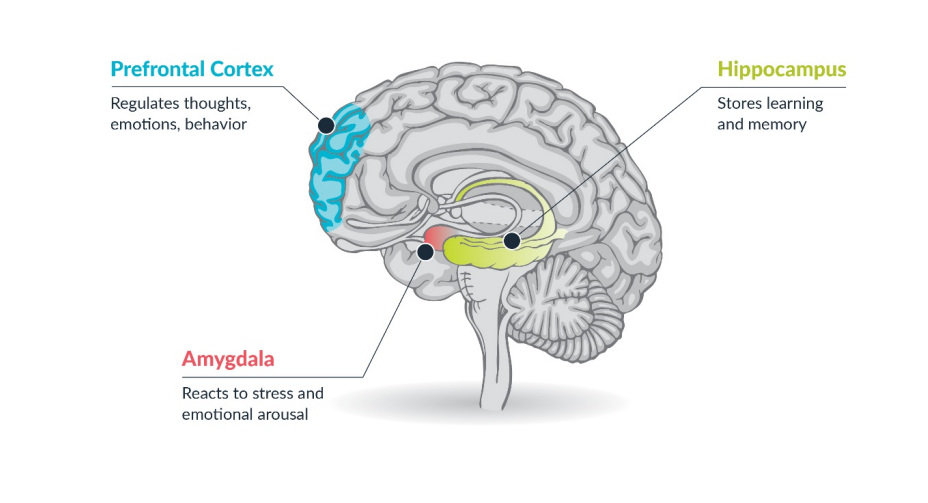
There are 3 structures in the brain that are mainly affected by traumatic events.
They are the prefrontal cortex, the amygdala, and the hippocampus:
AMYGDALA: The amygdala can be thought of as an alarm system – it causes a danger signal that activates your fight-or-flight responses. In people with PTSD, the amygdala is over-activated and responds dramatically to innocent stimuli, like fireworks or the sight of brake lights.
PREFRONTAL CORTEX: The prefrontal cortex is your brain’s braking system. It is able to receive and analyze the signals coming from the amygdala so that you can respond calmly and rationally. Traumatized people have an under-active prefrontal cortex, which means it is not as effective at getting these signals and reacting to them appropriately.
HIPPOCAMPUS: The hippocampus is the memory center of the brain. You can think of it as someone taking notes, date-stamping them, and filing them in the right cabinet. With trauma, the hippocampus may write down the memories incorrectly, fail to stamp them with the right date, or file them in the wrong cabinet. This leads to memory loss as well as the feeling that the traumatic memory is actually occurring in the present moment.

Why Do Only Some People Develop PTSD?
As mentioned, not everyone will develop PTSD after experiencing or witnessing a traumatic event. The main reason for this is individual differences in genetics, brain structure, psychological makeup, personality, upbringing, etc.
There isn’t one particular trait that can decide whether you get PTSD. Usually, multiple traumatic events that happen overtime, especially in childhood, can be more likely to cause PTSD.
One thing is for sure – having PTSD does not mean you are somehow “weak” or “defective.” It is a very human response to a horrible, tragic event that got you “trapped.”
Can PTSD Be Passed Down?
It is now a scientific fact – psychological trauma can be passed down to future generations through chemical changes in DNA. Studies found that children of traumatized people can have higher rates of depression and anxiety and be more likely to die by suicide. This effect was seen in children of Holocaust survivors and Vietnam war veterans.
In additional to biological changes, trauma often causes behavioral changes in parents, further increasing their children’s chances of inheriting these unhelpful traits.
For example, a well-meaning parent with PTSD may not spend much time with their child because of avoidance, inadvertently causing them to grow up in isolation and emotional neglect.
Does PTSD Affect Relationships?
There is no question that PTSD has a deeply negative effect on the survivor’s relationships.
Intrusion and reactivity symptoms may make the person feel weird in social situations as their reactions are misunderstood by others. Avoidance, of course, leads to not being social altogether. The more the traumatized person avoids their loved ones, the less welcome they feel.
Negative thoughts and mood follow avoidance, further pushing the traumatized person into isolation.
This is especially dangerous because PTSD symptoms are worsened without social support. Family ties, romantic relationships, and friendships can all be negatively affected by this diagnosis.
Can PTSD Be Cured?
You've probably typed those exact words into a search bar, maybe late at night, hoping for a yes. It's a fair thing to want.
So, here's the honest answer: PTSD isn't "cured" the way an infection clears with antibiotics, but that doesn't mean you're stuck with it forever. What treatment actually does is change your relationship to the trauma.
With approaches like EMDR, IFS, and somatic work, the memories that once hijacked your body lose their grip. The flashbacks quiet. The hypervigilance loosens.
Many people reach a point where symptoms no longer run the show, and some no longer meet the criteria for PTSD at all. Your nervous system learned to brace for danger that's no longer here.
The good news is that it can learn something different. Not by forgetting what happened, but by finally understanding it's safe to stop bracing.

Do I Need a PTSD Diagnosis to Get Treatment?
Whether or not you need a PTSD diagnosis depends on your insurance situation.
Insurance companies and government healthcare programs generally require a diagnosis before they will reimburse your therapist or doctor for treatment.
Your provider could diagnose you with something like adjustment disorder in the beginning, simply to be able to provide care for you before they can really explore your symptoms.
You could also be diagnosed with depression, bipolar disorder, anxiety, ADHD, OCD, substance use disorder, and other conditions, all of which are common along with PTSD. Sometimes, PTSD can masquerade as one of these disorders, with avoidance symptoms imitating anxiety or OCD and negative mood mimicking depression.
If you are paying out of pocket for your treatment, you don’t need a diagnosis to receive therapy for trauma. However, having a diagnosis can male you feel validated.
What Is Complex PTSD?
If the symptoms in this post sound familiar but the picture still feels incomplete, there's a reason for that. Complex PTSD (sometimes called C-PTSD) develops not from a single traumatic event, but from trauma that repeated over time, usually when you couldn't escape it.
Think childhood abuse or neglect, long-term domestic violence, or growing up with a caregiver you could never quite predict. The trauma could even be pre-verbal.
It includes all the hallmarks of PTSD, the flashbacks, the hypervigilance, the avoidance, but it adds another layer that cuts deeper.
People with C-PTSD often struggle with a harsh inner critic, overwhelming shame, trouble regulating emotions, and a shaky sense of who they are. Relationships feel especially fraught, because the danger didn't come from a car crash or a natural disaster. It came from people who were supposed to keep you safe.
That's not a character flaw, and it's not something you failed to "get over." It's what happens when a nervous system spends years bracing for harm that kept coming back.

What Are the Best Therapies for PTSD?
Ultimately, there is no way of knowing which therapy will work best for your unique situation. There is no one-size-fits-all treatment for PTSD, but there are some widely accepted methods that tend to work for most people:
EYE MOVEMENT DESENSITIZATION AND REPROCESSING (EMDR) and similar techniques, like advanced resolution therapy (ART) involve the traumatized person accessing the painful memories through visual images, emotional states, and/or body sensations while the brain is being stimulated in some way so it can finish digesting the memory. EMDR therapy can uses multiple types of stimulation, which always alternates between right and left side of the body: eye movements, vibrating hand-held devices, audio tones, and tapping.
COGNITIVE PROCESSING THERAPY (CPT) involves recalling and discussing traumatic memories with the therapist, who will point out irrational and unhelpful thoughts. CPT also requires the survivor to write extensively about the trauma, putting their feelings in words. This helps verbally process the trauma, which is stored in the non-verbal parts of the brain. This therapy can be initially activating because of the need to describe the trauma.
INTERNAL FAMILY SYSTEMS (IFS) works from the idea that the mind is made up of different "parts," each carrying its own job, fear, or burden. After trauma, some parts get stuck in protective roles. They might keep you hypervigilant, numb you out, or push the painful memories far out of reach. Rather than fighting these parts or trying to silence them, IFS therapy helps the survivor turn toward them with curiosity, get to know what each one is protecting, and access the calm, grounded core often called the Self.
There are many other types of therapy to treat PTSD, and they should be explored before committing to one method. It is always a good idea to ask a potential therapist what approach they use and how they go about making sure that you do not feel overwhelmed and terrified. It is important to finish treatment once you start so that the traumatic memories can be fully processed.

You Don't Have to Stay Where the Trauma Left You
Here's what's easy to lose sight of when you're in the thick of it: the symptoms you've been reading about are not your personality. They're not who you are. They're what your nervous system did to keep you alive when something overwhelming happened, and then kept doing long after the danger passed.
That distinction matters. An over-active amygdala, a misfiled memory, a body that braces at the sound of brake lights, these are injuries, not character flaws. And injuries can heal.
You don't have to white-knuckle your way through this alone, and you don't have to wait until things get "bad enough" to deserve help. Whether you carry a formal PTSD diagnosis or just the quiet sense that something hasn't been right for a long time, treatment can change the story your body keeps telling.
The memories don't disappear. But they stop running the show. The flashbacks soften. The constant scanning for threat loosens its grip. You start to feel like yourself again, sometimes like yourself for the first time.
If any part of this post made you feel seen, that's not an accident. It's a sign that some part of you is ready to stop bracing.
When you are, help is here.